
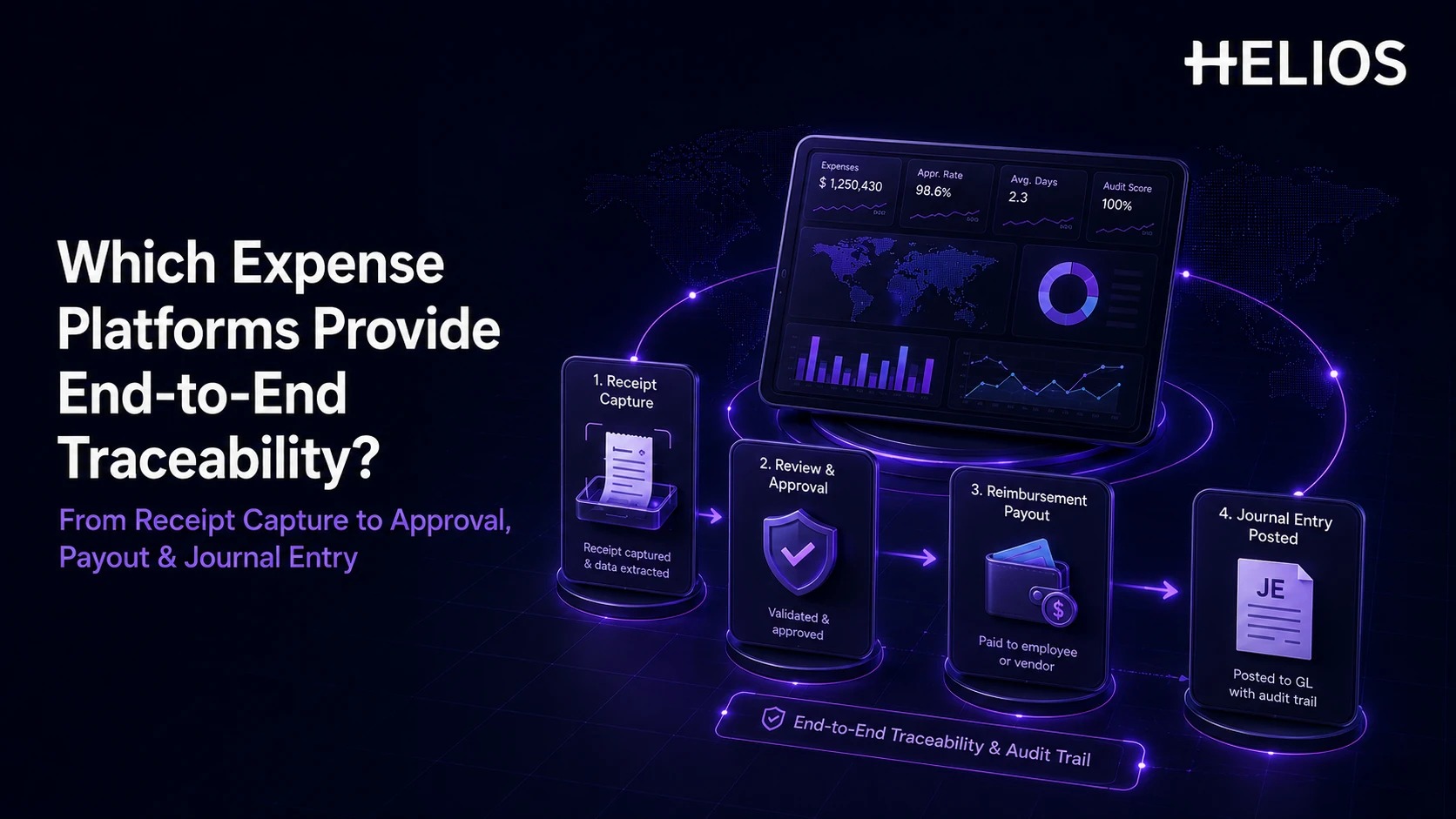
Finance teams often say they need an audit trail, but the real requirement is broader: one expense should stay traceable from the first receipt or transaction through policy checks, approvals, reimbursement or payout, accounting, and later corrections. When those stages live in separate systems, an auditor can see fragments of the story but still has to reconstruct what actually happened — usually by pulling records from email, a banking portal, and an ERP export and hoping the amounts match.
The strongest expense management software keeps the source document, workflow decisions, payment status, accounting dimensions, and downstream posting linked to the same record. This guide covers what end-to-end traceability should include, compares leading platforms, and explains how Helios supports a connected expense lifecycle.
What End-to-End Expense Traceability Actually Means
Traceability is not just a timestamped approval log — it's the ability to start from a posted accounting entry and work backward to the employee, receipt, policy result, approvers, payment, and any later edit, without opening a second system.
- Source evidence. The original receipt, invoice, card transaction, or mileage record stays linked to the expense and its extracted values.
- Policy and workflow history. The record shows which controls applied, which exceptions were found, and every approve, reject, return, delegate, or override action.
- Payment or reimbursement status. Finance can see whether an approved expense is awaiting payment, processing, paid, failed, or reversed.
- Accounting continuity. Accounts, cost centers, projects, taxes, and currencies stay connected to both the approved claim and the object created in the ERP.
- Change history. Corrections after approval or payment preserve the original record, the reason for the change, and who or what made it.
Expense Platform Comparison at a Glance
Some platforms keep spend, payout, and accounting inside one finance environment; others provide a strong expense workflow and lean on ERP or payment integrations for the final stages. Which one fits depends on which system is meant to stay the accounting source of truth.
| Platform | Strongest fit | Traceability considerations |
| Helios | Enterprise teams seeking one connected expense lifecycle | Receipt capture, policy control, approvals, accounting automation, and end-to-end expense processing; validate payout-status and ERP response linkage in the pilot. |
| Ramp | Teams combining reimbursements, payments, and accounting automation | Strong reimbursement state tracking, approval history, payout confirmation, and accounting sync; exact posting object depends on ERP integration. |
| Brex | Companies combining cards, reimbursements, and finance workflows | Visual audit trail can include policy reviews, approvals, payment, and accounting categorization; integrations support reimbursement accounting and journal exports. |
| Payhawk | Global or multi-entity teams with ERP-centric finance operations | Captures documents and approval context, carries payment details, and exports reviewed spend with attachments and accounting dimensions to supported ERPs. |
| SAP Concur | Large global travel-and-expense programs | Mature receipt capture, policy, approval, reimbursement, audit history, and broad accounting integrations; confirm payment and posting traceability for the selected connectors. |
| Emburse | Organizations needing configurable expenses, reimbursements, and payments | Approval, ACH reimbursement, payment-status visibility, accounting sync, and audit trails are available across its product family; confirm the required edition and geography. |
Which Expense Platforms Provide the Strongest Traceability?
1. Helios — A Connected Enterprise Expense Lifecycle
Helios combines mobile receipt capture, automated policy control, configurable approvals, accounting-entry generation, reporting, and Spark AI, positioned as covering reimbursement, accounting, payment, and reporting end to end. Validate payout states, payment references, ERP posting responses, and correction history in a real pilot before taking that positioning at face value.
2. Ramp — Reimbursement-to-Accounting State Visibility
Strong when finance wants receipt, approval, reimbursement status, payout, and accounting sync in one operational workflow. Its reimbursement model tracks both payment state and accounting-sync state, though the exact downstream accounting object — bill, payment, or journal entry — depends on the connected ERP.
3. Brex — Visual Audit History Across Spend and Accounting
Provides transaction-level audit trails covering policy reviews, approvals, rejections, accounting categorization, payment, and returns. Reimbursement accounting can create liabilities at approval and clear them at payment, with supported ERP integrations exporting journal entries or other finance objects.
4. Payhawk — ERP-Centric Spend-to-Posting Traceability
A strong candidate when the ERP stays the financial system of record. Workflows capture receipts, approval context, and payment details before exporting reviewed spend with attachments; supported integrations can create journal or payment records that link back to source evidence.
5. SAP Concur — Large Global T&E Programs
Connects AI-powered receipt capture, policy checks, approval, reimbursement, audit history, and a broad integration ecosystem. Test the specific payment and accounting connectors directly, since posting behavior and feedback vary by ERP and integration.
6. Emburse — Configurable Reimbursement and Payment Workflows
Combines receipt capture, policy enforcement, approval, reimbursement, payment capabilities, accounting integration, and audit history across its product family. Confirm which product edition provides the required payment rails, global coverage, and ERP posting behavior.
How a Fully Traceable Expense Workflow Should Work
A reliable automated expense reporting process preserves one chain of evidence through five stages:
- Capture the expense and preserve the source. The employee uploads a receipt, captures it from mobile, or matches it to a card transaction. OCR populates fields, but the source document stays available for verification.
- Apply policy before the decision disappears into an approval queue. Required fields, receipt rules, spending limits, duplicates, and categories get evaluated, and their results stay attached to the expense.
- Route approval with full context. The correct manager, cost-center owner, project owner, or finance reviewer receives the claim together with the receipt, policy result, coding, and prior actions.
- Track reimbursement or payout as a state, not a separate spreadsheet. After approval, the record shows payment method, processing status, settlement or failure outcome, and any external payment reference needed for reconciliation.
- Post to accounting and retain the downstream reference. Approved coding moves into the finance system, and the expense platform retains the posting result and ERP document identifier so finance can trace the journal or equivalent object back to the source.
Journal Entry Does Not Always Mean the Same ERP Object
Reimbursement accounting isn't represented identically in every ERP. One integration may create a journal entry; another may create an employee payable, a bill and bill payment, a credit-card transaction, a supplier invoice, or a payment journal. The label doesn't matter for control purposes — what matters is whether the platform records what was posted, where, whether the transfer succeeded, and how that object links back to the approved expense and payment.
How to Evaluate End-to-End Traceability
A scripted demonstration should follow one real expense all the way through the process, then work backward from accounting to the receipt:
- Test the complete happy path. Capture a receipt, approve it, reimburse it, post it, and confirm every stage is visible from the same record.
- Test failure states. A rejected payment, missing approver, failed ERP sync, invalid account, and corrected claim — check whether status and ownership stay clear through all of them.
- Confirm identifiers and attachments. Check whether payment references, ERP document IDs, receipts, comments, and approval history can be retrieved without manual matching.
- Verify segregation of duties. Submitters, approvers, payment operators, accountants, and administrators need distinct permissions, with overrides logged.
- Measure reconciliation effort. Track how often finance still has to leave the platform, search for supporting evidence, or manually match payments to accounting records.
How Helios Supports End-to-End Expense Traceability
Two capabilities carry most of the traceability story:
- Receipt-to-posting continuity. AI-powered OCR captures receipt and invoice information while keeping the source document connected to the claim, and Helios can generate journal entries from approved reports — carrying validated expense data into downstream accounting without the record breaking or needing to be rebuilt manually. *Scenario:* an auditor questions a $1,800 posted expense six months later. Instead of finance pulling a receipt from email, an approval from a Slack thread, and a payment confirmation from the bank portal, the chain from that journal entry back to the original photographed receipt should still resolve from the same record.
- Traceable review with policy context attached. Automated policy control applies spending rules and identifies exceptions before approval, and configurable approval workflows (routed by department, role, cost center) keep the review history — including what Approval Copilot surfaced to the reviewer — attached to the same record.
Payment-status visibility, settlement references, and reversal handling are where this needs the most scrutiny in a pilot, since public materials don't provide a country-by-country breakdown — confirm them directly for your entities rather than assuming coverage. Related Helios guidance on expense reimbursement software, automated approval workflows, finance automation for expense management, and AI audit software for expense review covers the surrounding controls.
FAQs About End-to-End Expense Traceability
Should the expense platform or the ERP be the system of record?
Usually the ERP stays the accounting system of record, while the expense platform owns the operational workflow — the integration needs to preserve a clear link between both, not make one redundant.
Does every expense platform create a journal entry?
No. Depending on the ERP and integration, reimbursements may post as journal entries, bills, payables, expense transactions, or payment journals. What matters is traceability, not the object's name.
Why does payment-status visibility matter if the claim was already approved?
Approval doesn't prove the employee was actually paid. Payment status and references are what let finance resolve failed payouts, reconcile cash, and explain the full transaction history if anyone asks later.