
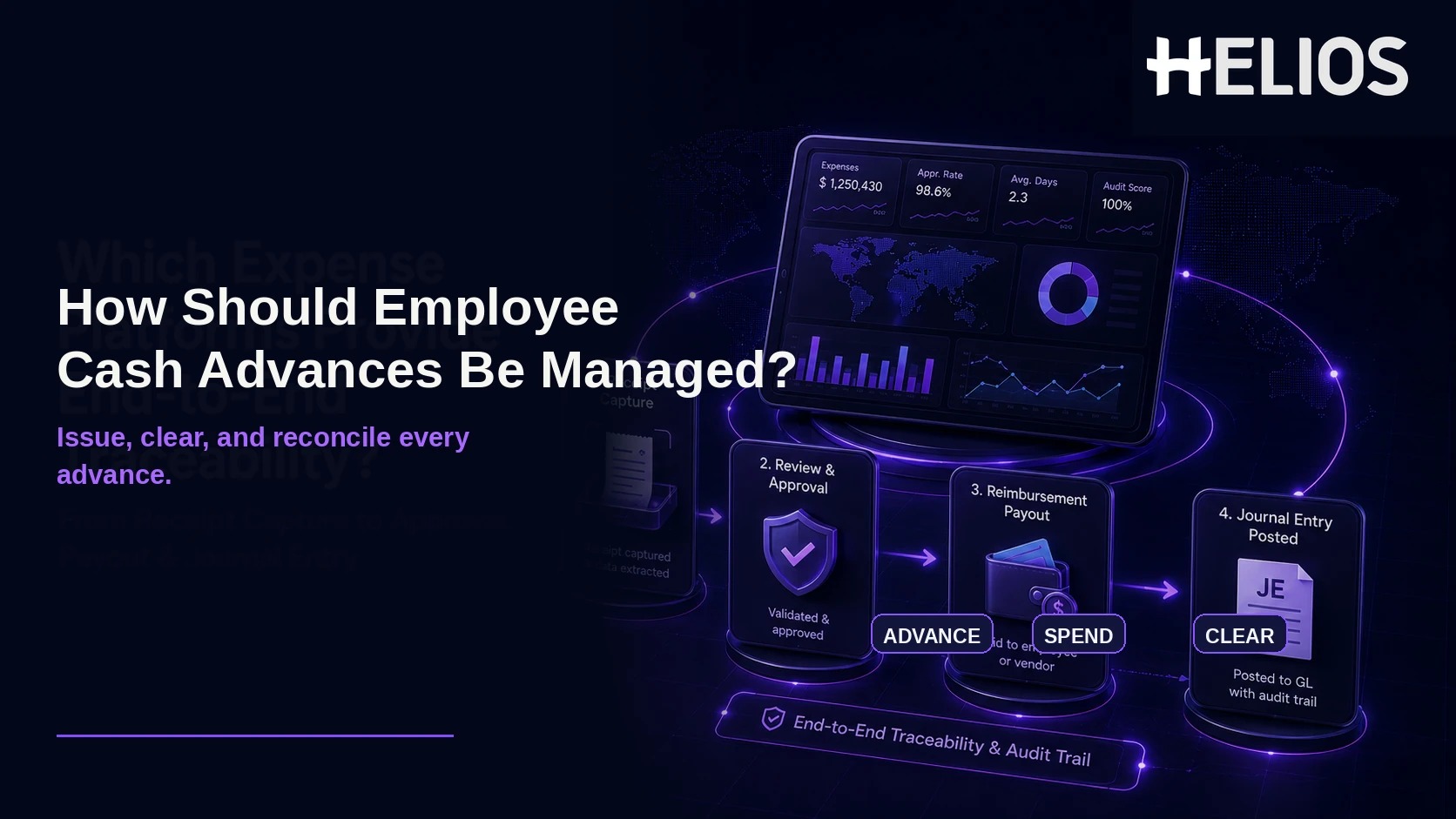
Employee cash advances are useful when an employee must spend for business before a company card, direct supplier payment, or normal reimbursement is practical. They are also easy to lose control of if finance treats the advance as an expense at the moment cash leaves the bank.
A strong process keeps the advance separate from the eventual business expense. The company approves an expected amount, records an open balance by employee, matches actual evidence to that balance, settles any difference, and closes the advance only when finance can reconcile the employee, payment, expense report, repayment or top-up, and general-ledger posting.
When Should Employee Cash Advances Be Used?
Cash advances should be an exception to the normal payment model, not an informal alternative to procurement or corporate cards. They are most useful when employees face genuine cash or access constraints—for example remote fieldwork, locations with low card acceptance, certain group travel situations, or an urgent business need where another approved payment method cannot be arranged in time.
· Use an advance only for a defined business purpose and expected period, with a named employee accountable for the funds.
· Check whether the employee already has an uncleared advance before issuing another one.
· Set an amount based on a reasonable estimate, local limits, trip length, currency needs, and risk—not a convenient round number.
· Prefer traceable bank transfer or other controlled disbursement methods over physical cash wherever practical.
The End-to-End Cash Advance Lifecycle
The control objective is simple: an advance should remain visible as an open employee balance until it is supported by approved business expenses or returned. The exact account names vary by ERP and chart of accounts, but the lifecycle should remain traceable from request through final settlement.
| Stage | Required control | Finance / accounting outcome |
| Request | Business purpose, expected spend, currency, dates, employee, cost object, prior advances. | Creates an approved advance request; no expense is recognized yet. |
| Issue | Pay only the approved amount; record employee, entity, currency, payment reference, due date. | Typically debit Employee Advances / credit Cash or Bank, subject to the company COA. |
| Spend & evidence | Capture itemized receipts, business purpose, tax details, and actual currency paid. | Evidence accumulates against the open advance balance. |
| Clear | Match approved business expenses to the advance and reject or escalate unsupported items. | Debit expense / tax accounts and credit Employee Advances for substantiated spend. |
| Settle difference | Employee returns unused cash, or company pays an approved over-spend. | Return: debit Cash / credit Employee Advances. Top-up: clear the remaining employee payable or pay directly. |
| Reconcile & close | Confirm zero balance, ledger posting, payment/repayment reference, and audit trail. | Advance is closed; any unresolved balance remains visible for follow-up or payroll/tax review. |
The key accounting point is that issuing an advance generally does not create the final travel, meal, project, or other business expense. Many organizations record an employee advance or employee receivable first, then recognize the actual expense only after the employee submits substantiation and finance approves it. The company should confirm the exact posting treatment with its accounting policy and ERP design.
What Evidence Is Needed to Clear an Advance?
Clearing should be evidence-based. An expense report should identify the original advance and contain the same information finance would require for an ordinary reimbursement: date, merchant or payee, amount and currency, business purpose, category, tax information where relevant, and the correct entity, department, cost center, client, or project.
· Itemized receipts or invoices for actual-cost items, not only card slips or payment screenshots.
· Trip, event, site, client, or project context showing why the cost was incurred for company business.
· Proof of any cash returned to the company and the bank/payment reference for the refund.
· Documented treatment for missing receipts, personal items, or disputed spend instead of clearing them silently.
How to Settle Under-Spend, Over-Spend, and Exceptions
Every cleared advance ends in one of a small number of settlement outcomes. Defining them in policy prevents unexplained employee balances and gives payroll, tax, and accounting teams a consistent handoff.
| Scenario | Settlement logic | Example |
| Actual spend = advance | Clear the full advance to approved expenses. | Advance $500; approved spend $500 → outstanding advance becomes $0. |
| Actual spend \< advance | Employee returns the unused amount; do not leave it as an unexplained credit. | Advance $500; approved spend $360 → employee returns $140. |
| Actual spend \> advance | Clear the advance and reimburse only the approved excess. | Advance $300; approved spend $450 → company pays employee $150. |
| Unsupported / personal spend | Do not clear unsupported amounts to business expense. Recover them or route them to the required payroll/tax process. | Advance $500; only $420 substantiated → $80 remains due from employee until resolved. |
| Foreign-currency difference | Use the approved reimbursement FX policy and separately identify material FX differences where required. | Advance in USD, spend in EUR → claim converted under the company cross-border reimbursement policy. |
For cross-border advances, use the same documented FX methodology as other employee reimbursements. See the Helios guide on cross-border reimbursement exchange rates for how transaction-date, actual settlement, statement, payroll, and month-end rates serve different purposes.
How Long Should Employees Have to Clear an Advance?
Use a clear internal deadline tied to the end of the trip, event, or purpose—for example a defined number of business days after return—and configure reminders and escalation. The deadline should be practical for local operations but short enough that advances do not become a permanent employee receivable.
Tax rules may impose their own timing expectations. In the United States, the IRS accountable-plan safe-harbor examples generally treat an advance made within 30 days of the expense, substantiation within 60 days after the expense, and return of excess within 120 days as reasonable. That is a U.S. example, not a global policy template. Other countries can treat advances differently, so local payroll and tax owners should validate the rules that apply to each entity.
A useful control is to block or escalate new advances when an employee has an overdue balance, while preserving an exception process for genuine operational emergencies. A quarterly outstanding-advance statement can also support follow-up, but finance should not wait until quarter-end to chase high-risk or material items.
A Five-Step Operating Model for Cash Advance Control
- Define eligibility and limits. Specify which roles, purposes, countries, trip types, and situations can use advances. Set approval thresholds, prohibited uses, maximum open balances, and whether multiple concurrent advances are allowed.
- Create a controlled request and disbursement. Require expected purpose, dates, amount, currency, cost object, and approver before payment. Link the payment reference to the advance record so finance can trace the bank movement back to the request.
- Capture evidence against the same advance. Employees should submit receipts and business purpose against the original advance rather than creating an unrelated reimbursement. The system should show the original amount, approved spend, unused balance, and any excess due to the employee.
- Settle the difference and clear the balance. Recover unused cash, reimburse approved over-spend, and route unsupported or personal amounts to the correct recovery, payroll, or tax process. Do not close the advance while a material unexplained balance remains.
- Reconcile and monitor. Reconcile outstanding advances by employee and entity to the GL at a defined cadence. Track aging, overdue balances, repeat exceptions, write-offs, FX differences, missing receipts, and advances issued before old ones were cleared.
Common Cash Advance Control Failures
· Expensing the advance at issue. This hides the open employee balance and makes later settlement harder to reconcile.
· Allowing multiple uncleared advances. Repeated top-ups can turn an operational tool into an uncontrolled employee receivable.
· Clearing to a generic expense account without evidence. Finance loses category, tax, project, and audit detail.
· Ignoring small residual balances. Individually small differences can become material when multiplied across a global workforce.
· Using payroll as a silent cleanup mechanism. Payroll deductions or taxable treatment may require employee consent, labor-law review, or local tax handling.
· Treating every country the same. Advance timing, employee-tax treatment, recovery methods, and documentation rules can differ by jurisdiction.
How Helios Can Support Employee Cash Advance Governance
Helios's public product pages describe mobile expense submission, AI-powered receipt capture, automated policy control, configurable approval workflows, automatic journal-entry generation, and multi-dimensional reporting — but they do not currently describe a dedicated cash-advance subledger or module. Companies should validate request, outstanding-balance, settlement, and aging requirements in a tailored demo or pilot rather than assume they exist out of the box.
- Capture and control what happens after the advance is issued. Employees can submit evidence and supporting documents from a mobile device as soon as they return, and configured policy rules can enforce eligible categories, receipt requirements, and amount limits before the claim reaches finance. Approval paths can route advance-related requests and missing-receipt exceptions by department, role, or cost center — whether overdue-balance aging specifically can trigger that same routing is a configuration question to test, not something to assume. None of this replaces a purpose-built advance ledger — it controls the evidence and routing around whatever advance-tracking process finance builds.
- Keep the clearing entry linked to the original advance. Helios states that its accounting engine can automatically generate journal entries from expense reports. Finance should test the specific postings needed to clear an advance, return unused cash, and reimburse approved over-spend, and confirm the entity and cost-object detail survives that clearing step.
FAQs About Employee Cash Advances
Should a cash advance be recorded as an expense when it is paid?
Usually no. Many companies first record an employee advance/receivable and recognize the business expense when the employee substantiates it. Confirm the exact accounting policy and ERP posting design.
What happens if the employee spends less than the advance?
The unused amount should be returned through an approved, traceable method and matched to the open advance before it is closed.
What if approved expenses are higher than the advance?
Clear the original advance and reimburse only the approved excess, using the normal employee-payment and accounting process.
Can an uncleared advance become taxable compensation?
Potentially. Tax treatment depends on local law, substantiation, timing, and whether excess amounts are returned, so local payroll/tax review is important.
How often should finance reconcile open advances?
Use a regular cadence based on volume and risk, with more frequent follow-up for overdue, high-value, or repeated outstanding balances.